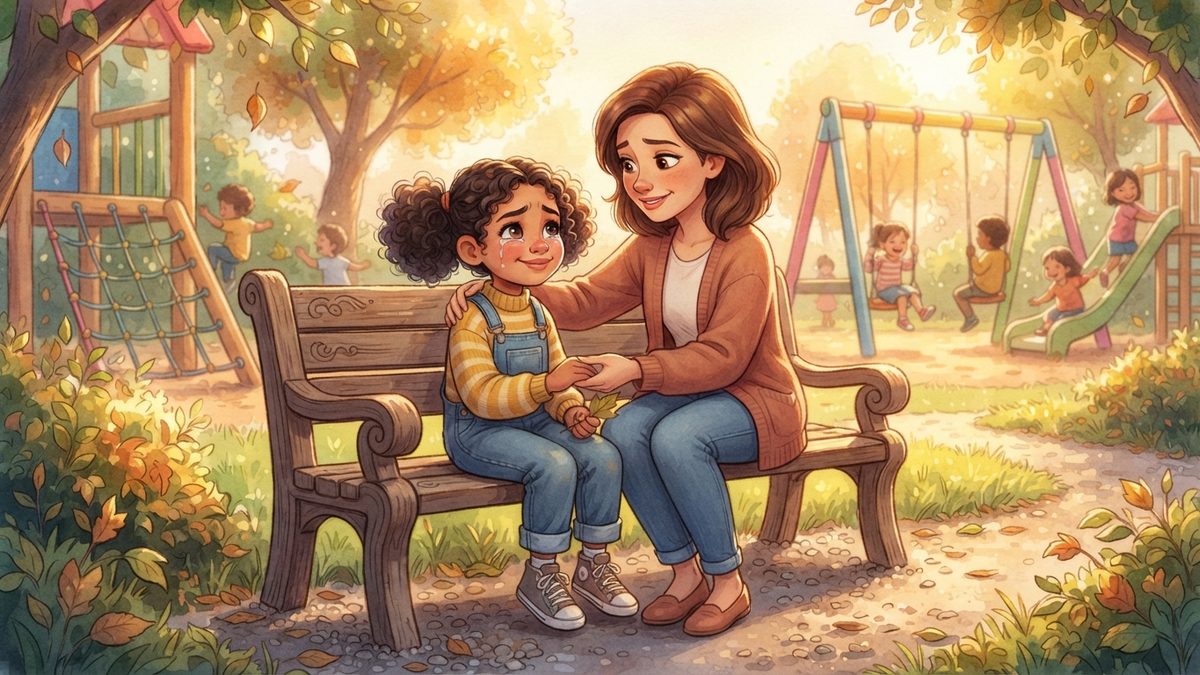
Every parent expects a certain degree of squabbling under their roof. Arguments over who sits in the front seat, who holds the tablet, or who built the taller block tower are standard developmental milestones. However, understanding the line between sibling bullying vs rivalry is critical for safeguarding your child's long-term emotional and neurological health.
When competitive friction morphs into persistent psychological domination, physical intimidation, or deliberate exclusion, it is no longer benign competition. It is sibling abuse, and leaving it unchecked can derail a child's sense of safety within their own home.
Children who experience sibling aggression and chronic victimization
Linked to equal or higher rates of clinical anxiety and depression compared to peer bullying
Sibling Bullying vs Rivalry: The Neurological & Clinical Differences #
Sibling rivalry is a natural byproduct of two or more developing brains learning social navigation, resource allocation, and emotional regulation. In healthy rivalry, conflicts fluctuate: power shifts back and forth, both children express remorse after an outburst, and both retain an underlying sense of security and mutual affection.
Sibling bullying, by contrast, relies on a persistent power imbalance. One child systematically targets, degrades, frightens, or isolates another, with little to no remorse.
The Neurobiology of Toxic Stress at Home #
The human home is meant to be a child's neurobiological safe harbor. When a child faces relentless hostility from a brother or sister, their nervous system perceives the home environment as chronically threatening.
According to research from the Harvard Center on the Developing Child, prolonged exposure to threat without the buffering presence of a protective adult activates the Hypothalamic-Pituitary-Adrenal (HPA) axis. This flooded state leads to:
- Elevated Basal Cortisol Levels: Keeping the child in a persistent state of hypervigilance, making restful sleep and sustained focus difficult.
- Amygdala Hyper-Reactivity: Heightening the brain's threat-detection center, which can lead to rapid emotional dysregulation and panic responses.
- Prefrontal Cortex Suppression: Impairing executive functioning, emotional self-regulation, and working memory.
When parents dismiss systematic aggression as "kids just toughening each other up," they inadvertently strand the targeted child in an environment of chronic toxic stress.
Clinical Psychologist Perspective on Sturdy Sibling Interventions #
Intervening in sibling aggression requires avoiding two common parenting pitfalls: permissive passivity ("work it out yourselves") and punitive authoritarianism ("go to your room and think about what you did").
Instead, developmental psychology advocates for Sturdy Warmth (Authoritative Parenting). This approach combines unwavering emotional validation with firm, non-negotiable physical and relational boundaries.
"Children do not need a judge, a jury, or a referee. They need a calm, sturdy leader who establishes clear physical boundaries while remaining an emotional anchor for both children. When safety is compromised, we step in immediately: connection first, clear boundary second, skill-building third."
— Dr. Laura Markham, Clinical Psychologist and Author of Peaceful Parent, Happy Siblings
If you notice your older or more dominant child exhibiting aggressive patterns, explore our comprehensive guide on what to do when your child is the bully for deeper behavioral frameworks.
Diagnostic Matrix: Sibling Rivalry vs Sibling Bullying #
To determine whether your household is experiencing developmentally normal friction or chronic sibling victimization, consult this clinical comparison matrix:
| Behavioral Dimension | Healthy Sibling Rivalry | Chronic Sibling Bullying |
|---|---|---|
| Power Balance | Fluid; both children assert themselves and win arguments intermittently. | Fixed; one child consistently dominates, controls, or intimidates the other. |
| Intent & Pattern | Spontaneous, situational, and driven by impulsive resource competition. | Targeted, repetitive, premeditated, or calculated to cause emotional distress. |
| Emotional Outcome | Both children recover quickly once the dispute is mediated; baseline affection remains intact. | The targeted child displays withdrawal, hypervigilance, bedwetting, or chronic anxiety. |
| Remorse & Empathy | The aggressor displays genuine guilt or distress when the other child is genuinely hurt. | The aggressor exhibits indifference, justification ("they deserved it"), or secret enjoyment. |
| Parental Role Required | Coaching conflict-resolution skills and active listening. | Immediate physical protection, firm boundary containment, and clinical intervention. |
The 4-Step "Sturdy Parent" Intervention Roadmap #
When a conflict escalates beyond standard bickering into verbal degradation or physical aggression, implement this closed-ended, predictable 4-step sequence immediately.
Step 1: Immediate Physical Separation (Zero Debate) #
Do not ask "Who started it?" in the heat of dysregulation. Adjudicating facts while nervous systems are flooded triggers defensive lying and escalated blame.
- Action: Place your physical body calmly between both children. Create immediate spatial safety without shoving, yelling, or snatching.
- Exact Script: "I am stepping in. My number one job is to keep everyone in this house safe. Hands to your own bodies. We are pausing right now."
Step 2: Attune to and Regulate the Targeted Child #
Your first relational priority is re-establishing safety for the child who was struck, demeaned, or overwhelmed.
- Action: Turn your torso toward the targeted child, get down to eye level, and offer steadying touch if welcomed.
- Exact Script: "You are safe. I am right here. That was too loud/rough, and I will not let anyone hurt your body or your feelings. Take a deep breath with me."
If you need deeper verbal frameworks to support a child experiencing ongoing distress, read our clinical guide with scripts to counsel a bullied child.
Step 3: Set Sturdy, Non-Shaming Limits with the Aggressor #
Turn to the aggressive child with calm authority. Acknowledge the underlying emotion while setting a non-negotiable boundary on the behavior.
- Action: Maintain relaxed shoulders, low vocal pitch, and direct eye contact. Do not shame, call them "mean," or threaten isolation.
- Exact Script: "I see how furious you were when she touched your Lego tower. It is okay to be furious. It is NOT okay to hit or call names. I will not let you hurt your sister, and I will not let her hurt you."
Step 4: Proactive Narrative Repair (Post-Regulation) #
Once both children have returned to a regulated baseline (usually 30 to 60 minutes later), facilitate restorative problem-solving.
- Action: Guide the children through perspective-taking rather than forcing an empty "I'm sorry."
- Exact Script: "When we get mad, our bodies feel like exploding. What could we do next time that anger gets big? Let's practice saying: 'I need space right now.'"
What to Say When Resistance and Defiance Occur #
Scenario A: The Aggressor Claims "It Was Just a Joke!" #
- The Pitfall: Debating whether the joke was funny or punishing sarcasm with anger.
- The Sturdy Script: "A joke is only a joke when both people are laughing. When one person is crying or asking to stop, it is no longer funny; it is hurtful. In our family, we stop the second someone says stop."
Scenario B: The Aggressor Blames the Victim ("He Annoyed Me on Purpose!") #
- The Pitfall: Validating the excuse or lecturing on fairness.
- The Sturdy Script: "He may have done something annoying, AND you are still completely responsible for what you do with your hands and your words. Being annoyed never gives us permission to be unsafe."
Scenario C: The Targeted Child Begins Hiding Incidents #
- The Pitfall: Getting frustrated that they did not speak up sooner.
- The Sturdy Script: "Thank you for telling me now. It takes courage to speak up when you feel overwhelmed. You never have to handle big, scary feelings or mean words alone. I am on your team, and I will handle this."
Rebuilding Sibling Empathy Through Bibliotherapy and Shared Stories #
Preventing sibling hostility requires more than just stopping fights—it requires actively exercising the brain's empathy circuits during calm, connective moments.
Developmental neurobiology shows that narrative immersion stimulates the Theory of Mind network—the neural architecture responsible for understanding that other people possess distinct thoughts, feelings, and perspectives.
Reading together creates a shared emotional experience that lowers household cortisol and fosters relational co-regulation.
How Fabella Cultivates Sibling Connection #
This is where the Fabella app becomes an essential tool in your parenting toolkit:
- Dual-Perspective Interactive Narratives: Fabella’s voice-narrated interactive stories place children in dynamic story scenarios where they must collaborate, make choices together, and navigate social-emotional dilemmas.
- Emotional Literacy Modeling: Characters model self-regulation, boundary-setting, and emotional repair, giving siblings a shared vocabulary for their own conflicts.
- Calm, High-Warmth Routines: Using Fabella for evening wind-downs creates an equitable, shared routine where neither child feels sidelined or favored.
By turning screen time into an intentional, narrative-driven empathy exercise, parents can help children transition from adversarial competitors to collaborative teammates.
Concrete Action Plan for Tonight at 7:30 PM #
Transform your household dynamics by implementing these three closed-ended practices tonight:
- Establish the "Safe Body, Safe Words" Household Policy:
Sit down together for 5 minutes before bedtime. Say: "In our family, everyone has the absolute right to feel safe in their body and their room. If anyone says 'Stop,' the action stops immediately. No exceptions." - Institute 10 Minutes of Protected One-on-One Time:
Spend 10 focused, uninterrupted minutes with each child individually. When children feel their emotional attachment to their parents is secure, their urge to compete through aggressive dominance decreases substantially. - Engage in a Shared Story Session:
Gather your children together with an interactive, emotionally intelligent story on Fabella. Discuss how the characters solved their disagreements, reinforcing that anger is normal, but kindness and safety are non-negotiable.
Frequently Asked Questions #
Is some physical roughhousing normal between siblings? #
Yes. Consensual roughhousing is a natural way for children to develop motor coordination and social boundaries. However, it ceases to be healthy play the moment one child wants to stop, exhibits fear, or when there is an uneven power dynamic where one child is consistently pinned, hurt, or distressed.
Should I force my children to hug and apologize after a fight? #
No. Forcing physical contact or insincere apologies teaches children to perform compliance rather than build genuine empathy. Focus first on physical separation and emotional regulation. Once calm, guide the aggressor to make a meaningful repair (e.g., helping rebuild a knocked-over tower, getting an ice pack, or offering verbal reassurance).
When should our family seek professional clinical support? #
Seek guidance from a licensed child psychologist or pediatric mental health professional if:
- Physical violence causes bruising, bleeding, or property destruction.
- The targeted child displays signs of clinical depression, regression (such as renewed bedwetting), intense panic, or school avoidance.
- Cruelty toward the sibling extends to animals or occurs entirely out of sight of parents in a calculated, covert manner.