Every parent wants their child to possess the moral courage to speak up when they witness cruelty. Yet, when peer conflict erupts on the playground, fear often takes over—not just for the child being targeted, but for the onlookers who witness it. Learning how to teach your child to stand up to bullies without placing themselves in physical, emotional, or social jeopardy is one of the most vital life skills you can provide during early childhood and elementary school.
Standing up to a bully does not mean trading insults, escalating physical aggression, or becoming a reckless vigilante. Instead, developmental science shows that the most effective intervention relies on calm, pre-rehearsed de-escalation techniques and strategic "upstander" behaviors.
By grounding children in emotional regulation, sturdy boundary-setting, and clear verbal scripts, we empower them to transform from passive bystanders into safe, confident defenders of their peers.
Bullying episodes that stop within 10 seconds when a peer intervenes
vs. ongoing escalation when bystanders remain silent
The Neurobiology of the Bystander: Why Kids Freeze #
When a child witnesses peer aggression or relational aggression in kids, their central nervous system undergoes rapid autonomic arousal. The amygdala perceives the social threat and triggers a sympathetic fight, flight, or freeze response.
For the vast majority of children, the instinct is to freeze or look away. This is not cowardice; it is neurobiological self-preservation.
According to research from the Harvard Center on the Developing Child, acute social stress triggers an immediate spike in cortisol and adrenaline. This physiological cascade temporarily dampens activity in the prefrontal cortex—the brain's executive control center responsible for speech formulation, problem-solving, and risk assessment.
Without pre-wired neural pathways and automated verbal scripts, a child's brain simply cannot innovate a witty, safe response in the heat of social conflict.
When children are equipped with automated, low-risk verbal frameworks, their prefrontal cortex retains access to executive functioning. They no longer have to guess what to do; their working memory retrieves an established script.
The Sturdy Parenting Approach to Bullying Defense #
Teaching self-advocacy and peer protection requires a delicate parenting balance. Permissive ("soft") parenting often dismisses playground dynamics with passive advice like "Just ignore them and they’ll go away"—which rarely works and leaves the target feeling isolated. Conversely, authoritarian ("hard") parenting pushes aggressive retaliation: "If someone pushes you, you punch them right back," which frequently leads to disciplinary suspension and physical danger.
The solution is Authoritative (Sturdy) Parenting: high warmth paired with firm, predictable boundaries.
"When a child faces social conflict, we cannot expect them to regulate their behavior if we haven't co-regulated their emotions first. Sturdy parenting means holding a safe, confident container: we validate the fear of speaking up, while equipping the child with clear, non-negotiable boundaries and actionable language."
— Dr. Daniel Siegel & Dr. Tina Payne Bryson, Authors of The Whole-Brain Child and The Power of Showing Up
| Challenge | Soft/Permissive Approach | Hard/Authoritarian Approach | Balanced Sturdy Solution |
|---|---|---|---|
| Peer Name-Calling | "Just ignore them; words can't hurt you." | "Call them a name back or push them." | "Look them in the eye, say 'Stop, that's not cool,' and walk away with your friend." |
| Witnessing Exclusion | "Go find someone else to play with." | "Demand that the teacher punish those kids." | "Walk directly up to the excluded child and say: 'Come play four-square with me.'" |
| Physical Intimidation | "Stay quiet so you don't get hurt." | "Hit them first so they respect you." | "Step back, use a strong stop-hand gesture, shout a firm boundary, and get an adult." |
## How to Teach Your Child to Stand Up to Bullies: The 4 Safe Upstander Strategies #
To eliminate ambiguity for your child, avoid broad instructions like "Be brave." Instead, teach the 4-D Upstander Framework, adapted by child psychologists for early childhood and elementary social environments.
1. Direct Intervention (The Calm, Firm Boundary) #
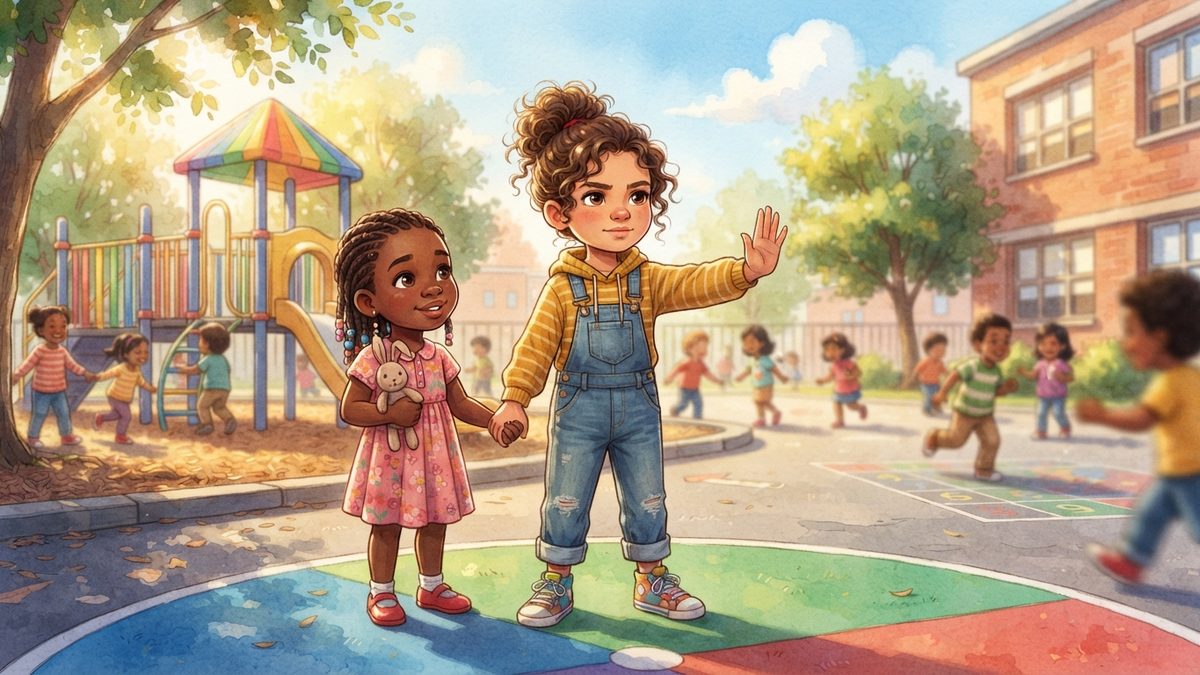
This strategy is used when the child feels physically safe and the aggressor is a peer of similar age or size. The goal is not to debate, insult, or lecture the aggressor, but to break the social power dynamic with a clear, neutral statement.
- The Body Language: Feet planted shoulder-width apart, shoulders back, eyes locked on the bridge of the aggressor's nose, palms out in a "stop" gesture.
- The Scripts:
- "That's not kind. We don't talk like that."
- "Stop. Leave him alone."
- "Knock it off, Maya. Let's go, Sam."
2. Distract (The Pattern Interrupt) #
Aggressors thrive on an audience and immediate emotional reactions. If your child feels hesitant about confronting the bully head-on, distraction removes the power dynamic without direct confrontation.
- The Mechanism: The upstander creates an artificial diversion that shifts everyone's attention away from the conflict.
- The Scripts:
- "Hey Leo, Coach said the soccer game is starting right now on field two!"
- "Look, Mr. Davis is calling our class over to the door!"
- "Sam, I need your help finding my lunchbox inside, come with me."
3. Delegate (Enlisting an Adult Sturdily) #
Children frequently withhold reporting because they fear being labeled a "tattletale." Teach your child the definitive developmental distinction between tattling and reporting:
- Tattling is trying to get someone into trouble over a minor, harmless rule break.
- Reporting is trying to get someone out of danger or emotional harm.
Teach your child to find a recess monitor, teacher, or coach using the Clear Observation Script:
"Mrs. Vance, I need your help. Alex is blocking Jordan in the corner and won't let him leave, and Jordan looks scared."
4. Delay (The Post-Incident Check-In) #
Sometimes an incident happens too fast for a child to intervene safely. The Delay strategy teaches children that being an upstander does not end when the bully walks away. Reaching out to the victim afterward mitigates the psychological isolation that causes trauma.
If your child's peer was recently targeted, guiding your child on how to counsel a bullied child gives them the exact words of solidarity to restore their friend's sense of belonging.
- The Scripts:
- "Hey, I saw what happened over there. That wasn't fair, and what they said isn't true."
- "Do you want to sit with me at lunch today?"
- "I'm sorry they were mean to you. Let's go swing."
The 7:30 PM Home Roleplay Routine: Building Muscle Memory #
You cannot teach de-escalation skills through lectures alone. Neural consolidation of social-emotional responses requires behavioral rehearsal. When children practice scenarios in a low-stakes, playful home environment, mirror neurons and somatic memory wire the response for high-stakes activation.
Follow this exact 4-step, 10-minute sequence during your evening wind-down routine:
Step 1: The Sturdy Stance (2 Minutes) #
Have your child stand in front of a full-length mirror.
- Tell them: "Show me your tree trunk legs." (Feet flat, grounded).
- "Show me your quiet hands." (Hands steady at sides or one hand held firmly out in a stop signal).
- "Show me your calm, unbothered face." (Neutral mouth, steady eye contact).
Step 2: The "Broken Record" Script (3 Minutes) #
Play the role of a mildly teasing peer (keep your tone light, not terrifying).
- Say: "You can't play with us today."
- Coach your child to use the exact three-word phrase: "We share this space."
- Whatever you say next ("No we don't!", "Go away!"), coach your child to repeat the exact same sentence in a flat, neutral tone: "We share this space."
- Limiting the child to one repetitive boundary prevents them from getting drawn into verbal sparring or emotional dysregulation.
Step 3: The Pivot & Escort (3 Minutes) #
Place a teddy bear or action figure on the rug, pretending it is a peer being teased.
- Teach your child to step up to the toy, make eye contact, say: "Hey, come play basketball with me," and physically escort the toy away from the imaginary conflict.
- This reinforces that upstanding is often about rescuing the target rather than fighting the aggressor.
Step 4: Sturdy Warmth Debrief (2 Minutes) #
Sit together on the bed or sofa and provide grounding validation:
"How did your body feel when you said that? It's normal for your heart to beat fast. You don't have to be fearless to be brave; you just need to know your words."
Using Bibliotherapy and Storytelling to Reinforce Moral Courage #
Reading stories where characters navigate social intimidation, bystander dilemmas, and assertive boundaries provides cognitive scaffolding. Developmental pediatricians refer to this as bibliotherapy—the clinical use of structured narrative to help children process complex social-emotional challenges safely from a psychological distance.
Through the role of imagination in child development, children step into the shoes of characters who face playground bullies, test out different response options, and observe the consequences without risking their own social status.
In the Fabella app, our interactive, voice-narrated storybooks place children at the center of social decision-making. By allowing young readers to choose how a character responds to a peer conflict—whether to speak up, distract the group, or seek an adult—Fabella transforms passive screen time into an active, brain-building rehearsal for real-world resilience.
Key Takeaways for Parents #
- Intervention stops bullying quickly: Research indicates that over half of peer harassment episodes end in seconds when a bystander intervenes sturdily.
- Replace lectures with scripts: A child experiencing fight-or-flight cannot improvise; they need automated 3-to-5 word phrases wired into procedural memory.
- Practice the 4 D's: Teach your child to choose between Direct, Distract, Delegate, and Delay based on the safety of the situation.
- Distinguish reporting from tattling: Ensure your child knows that asking an adult for help to keep a peer safe is an act of leadership, not weakness.
- Rehearse regularly at home: Use evening roleplay and interactive storytelling to build genuine somatic confidence long before playground conflict occurs.